


Buildings are continuously exposed to changing outdoor conditions, and temperature is one of the most important factors that can influence indoor comfort, energy consumption, material performance, and long-term building efficiency. In a climate such as Jaipur’s, where buildings can experience intense summer heat as well as seasonal temperature variations, managing heat transfer becomes an important part of construction planning. Thermal insulation is one of the solutions used to reduce unwanted heat flow through building elements and create a more controlled indoor environment. When appropriately designed and installed, an insulation system can complement other building measures such as efficient glazing, shading, ventilation, waterproofing, and energy-efficient equipment.
For builders, architects, contractors, developers, facility managers, and property owners looking for Thermal Insulation Jaipur solutions, choosing the right system involves much more than selecting an insulation material. The building’s location, roof and wall construction, exposure, intended use, temperature conditions, moisture considerations, installation quality, and project requirements should all be evaluated. Bituchem operates as a specialty contractor and authorized distributor of construction chemicals, combining products with technical guidance and professional application services. Its portfolio includes thermal and acoustic insulation solutions, while its wider construction expertise covers industrial, commercial, residential, infrastructure, healthcare, hospitality, warehouse, and institutional environments.
What Is Thermal Insulation?
Thermal insulation refers to materials and systems designed to reduce the rate at which heat moves from one area to another.
In a building, heat naturally moves from warmer areas toward cooler areas.
During a hot summer, outdoor heat can move through roofs, walls, ceilings, windows, and other building elements toward cooler interiors.
During colder conditions, heat generated inside a building can move outward.
A properly selected insulation system can reduce this heat transfer, helping the building maintain a more stable indoor temperature.
The effectiveness of an insulation system depends on several factors, including the material’s thermal properties, thickness, continuity, installation quality, moisture exposure, and the overall construction assembly.
This means that Thermal Insulation Solutions Jaipur should be selected according to project-specific requirements rather than treating every building as identical.
Why Thermal Insulation Is Important for Modern Buildings
Modern buildings are expected to provide comfort while also managing operating costs and resource consumption.
Heating and cooling systems can account for a significant portion of building energy use, particularly when a building envelope allows substantial heat transfer.
Thermal insulation can help reduce the thermal load placed on mechanical cooling or heating systems.
This can support more efficient building operation when insulation is correctly designed and combined with other energy-conscious measures.
For commercial and industrial properties, the potential benefits extend beyond occupant comfort.
A more controlled internal environment can be relevant to offices, warehouses, manufacturing spaces, hotels, hospitals, educational facilities, and other buildings where temperature conditions influence operations.
Bituchem’s stated focus includes residential and commercial buildings, industrial and manufacturing facilities, hotels and resorts, hospitals and healthcare facilities, warehouses and logistics centres, infrastructure, and educational institutions.
Thermal Insulation in Jaipur: Why Local Climate Matters
Jaipur experiences hot summers, seasonal monsoon conditions, and variations in temperature throughout the year.
These conditions make building-envelope performance particularly important.
A roof exposed directly to strong sunlight can absorb considerable heat, and poorly insulated roof assemblies may allow that heat to transfer into occupied spaces.
Similarly, walls and other exposed surfaces can contribute to unwanted heat gain.
This is why Thermal Insulation Jaipur projects should be approached with attention to local climate conditions and building design.
The correct solution may differ between a residential building, factory, warehouse, hotel, hospital, or office.
A technical assessment can help determine which surfaces require insulation, what type of system is appropriate, and how the insulation should integrate with other construction layers.
How Thermal Insulation Works
Thermal insulation works by slowing the transfer of heat through a building component.
Different insulation materials achieve this through their physical structure and thermal properties.
The objective is not necessarily to stop heat transfer completely.
Rather, the aim is to reduce the rate of heat flow to a level appropriate for the building’s design and performance requirements.
The overall result depends on the complete building assembly.
For example, installing insulation on one section of a roof while leaving major thermal bridges elsewhere may limit the system’s effectiveness.
Continuity is therefore an important consideration.
Proper detailing around joints, penetrations, edges, supports, openings, and transitions can be just as important as the insulation material itself.
Main Applications of Thermal Insulation in Buildings
Thermal insulation can be incorporated into different areas of a building depending on its construction and performance requirements.
Common applications include roofs, terraces, walls, ceilings, floors, cold-storage environments, industrial facilities, commercial buildings, and specialized structures.
The appropriate location depends on where heat transfer is occurring and what the building needs to achieve.
A professional assessment can identify the areas with the greatest thermal exposure.
Common applications include:
- Roof and terrace insulation
- Wall insulation
- Ceiling and slab insulation
- Industrial building insulation
- Warehouse insulation
- Commercial building insulation
- Residential building insulation
- Temperature-sensitive spaces
- Specialized industrial applications
The specific insulation material and installation method should be determined according to the building assembly and project requirements.
Roof Thermal Insulation
The roof is often one of the most exposed parts of a building.
It receives direct solar radiation and is exposed to rain, wind, dust, and temperature changes.
A roof without adequate thermal protection can contribute to increased heat transfer into the building.
Thermal Insulation Products Jaipur can be considered as part of a roof assembly where thermal performance is an important project objective.
However, thermal insulation should not be confused with waterproofing.
A waterproofing system primarily addresses water penetration, while thermal insulation addresses heat transfer.
In some projects, both systems need to work together.
Bituchem’s broader product portfolio includes waterproofing systems alongside thermal insulation, allowing project requirements to be considered as part of a wider building-protection approach.
Thermal Insulation for Walls
Walls can contribute to heat transfer depending on their orientation, construction, material, thickness, exposure, and surrounding conditions.
External walls exposed to direct sunlight may require particular attention in hot climates.
Wall insulation can reduce the movement of heat between external and internal environments.
However, the appropriate system depends on whether insulation is being installed externally, internally, or as part of a cavity or composite construction.
Moisture management should also be considered.
An insulation system that is poorly detailed or exposed to inappropriate moisture conditions may not perform as intended.
This is why professional planning is important when selecting Thermal Insulation Material Jaipur solutions for wall assemblies.
Thermal Insulation for Commercial Buildings
Commercial buildings have diverse requirements.
An office may prioritize indoor comfort and energy management.
A retail property may have large glazed areas and significant cooling requirements.
A hotel may need to maintain comfortable conditions across guest rooms and common areas.
A hospital has additional operational requirements related to comfort, hygiene, equipment, and facility management.
Thermal insulation can form one part of the building-envelope strategy for these environments.
For a commercial project, insulation selection should consider occupancy patterns, air-conditioning requirements, roof construction, wall systems, local weather conditions, maintenance access, and the intended lifespan of the building.
Thermal Insulation for Industrial Buildings
Industrial facilities often have more complex thermal requirements than conventional buildings.
Factories, manufacturing units, processing facilities, and plants may contain equipment that generates heat or requires controlled temperatures.
Some industrial processes may also have specific environmental requirements.
In such cases, insulation is not simply an architectural feature.
It can become part of the operational environment.
Bituchem specifically identifies industrial and manufacturing plants as a focus area and provides specialty contracting solutions across demanding industrial environments.
For an industrial project, engineers should consider process temperatures, equipment arrangement, operating conditions, accessibility, safety, moisture, and maintenance requirements before selecting a system.
Thermal Insulation for Warehouses
Warehouses and logistics facilities can have large roof areas and significant internal volumes.
A poorly controlled thermal environment can affect working conditions and, depending on the stored materials, may also influence storage requirements.
The appropriate insulation strategy depends on the warehouse structure, roof system, stored goods, ventilation, equipment, and operating conditions.
For facilities with temperature-sensitive products, insulation requirements may be substantially different from those of a conventional storage warehouse.
Bituchem lists warehouses and logistics centres among the sectors it serves.
Thermal Insulation for Residential Buildings
Residential buildings can benefit from thermal insulation as part of a broader approach to indoor comfort.
Roofs, external walls, ceilings, and other exposed building elements can contribute to heat gain.
In hot climates, roof insulation can be particularly relevant because the roof receives prolonged solar exposure.
A residential insulation strategy should consider the building orientation, construction materials, window area, shading, ventilation, air-conditioning requirements, and local weather.
Insulation is most effective when considered during building design, although retrofit solutions may also be possible depending on the structure.
Thermal Insulation for Hotels and Resorts
Hotels and resorts need to maintain comfortable indoor conditions for guests while managing operational costs.
Guest rooms, restaurants, kitchens, corridors, conference spaces, and service areas may have different thermal requirements.
Insulation can be integrated into building-envelope and mechanical-system planning.
For hospitality projects, the design should also consider acoustic performance, since thermal and acoustic comfort can overlap in some building assemblies.
Bituchem lists hotels and resorts among its application sectors and provides both thermal and acoustic insulation as part of its specialist construction services.
Thermal Insulation and Energy Efficiency
One of the key reasons building owners consider insulation is energy efficiency.
When unwanted heat transfer is reduced, cooling or heating systems may not need to work as intensively to maintain the desired indoor temperature.
The actual energy savings depend on many factors.
These include climate, building design, insulation level, HVAC efficiency, occupancy, operating schedule, windows, air leakage, solar shading, and user behaviour.
Therefore, it is better to view insulation as one component of an integrated energy strategy rather than expecting insulation alone to deliver a fixed percentage of savings.
Thermal Insulation and Indoor Comfort
Indoor comfort is not determined by air temperature alone.
Surface temperatures, air movement, humidity, clothing, activity levels, and other environmental conditions can influence how occupants experience a space.
Building-envelope insulation can help reduce unwanted heat movement through walls and roofs.
This may contribute to more stable indoor conditions.
For offices, homes, schools, hospitals, hotels, and other occupied buildings, this can be an important consideration.
The system should nevertheless be designed according to the building’s actual requirements.
Thermal Insulation and Building Durability
Insulation is primarily associated with thermal performance, but the wider building assembly also matters for durability.
Poorly designed building-envelope systems can create moisture problems, condensation, thermal bridges, or material deterioration.
This is why thermal insulation should be coordinated with waterproofing, vapour control where required, structural detailing, drainage, and surface protection.
Bituchem’s wider construction portfolio includes waterproofing, structural strengthening, protective coatings, joint solutions, specialized repairs, anchoring, and other construction chemical applications.
This broader technical background can be useful when insulation needs to integrate with other building-protection systems.
Types of Thermal Insulation Materials
There is no single insulation material suitable for every project.
Different materials have different thermal, physical, mechanical, moisture, fire, installation, and cost characteristics.
Common categories used in construction can include rigid boards, flexible insulation, mineral-based products, polymer-based insulation, sprayed systems, reflective systems, and specialized assemblies.
The correct choice should be based on engineering requirements rather than simply selecting the material with the lowest purchase price.
Important factors include thermal conductivity, thickness, compressive strength, moisture behaviour, dimensional stability, fire performance, compatibility with adjacent materials, and expected service conditions.
Thermal Insulation Board
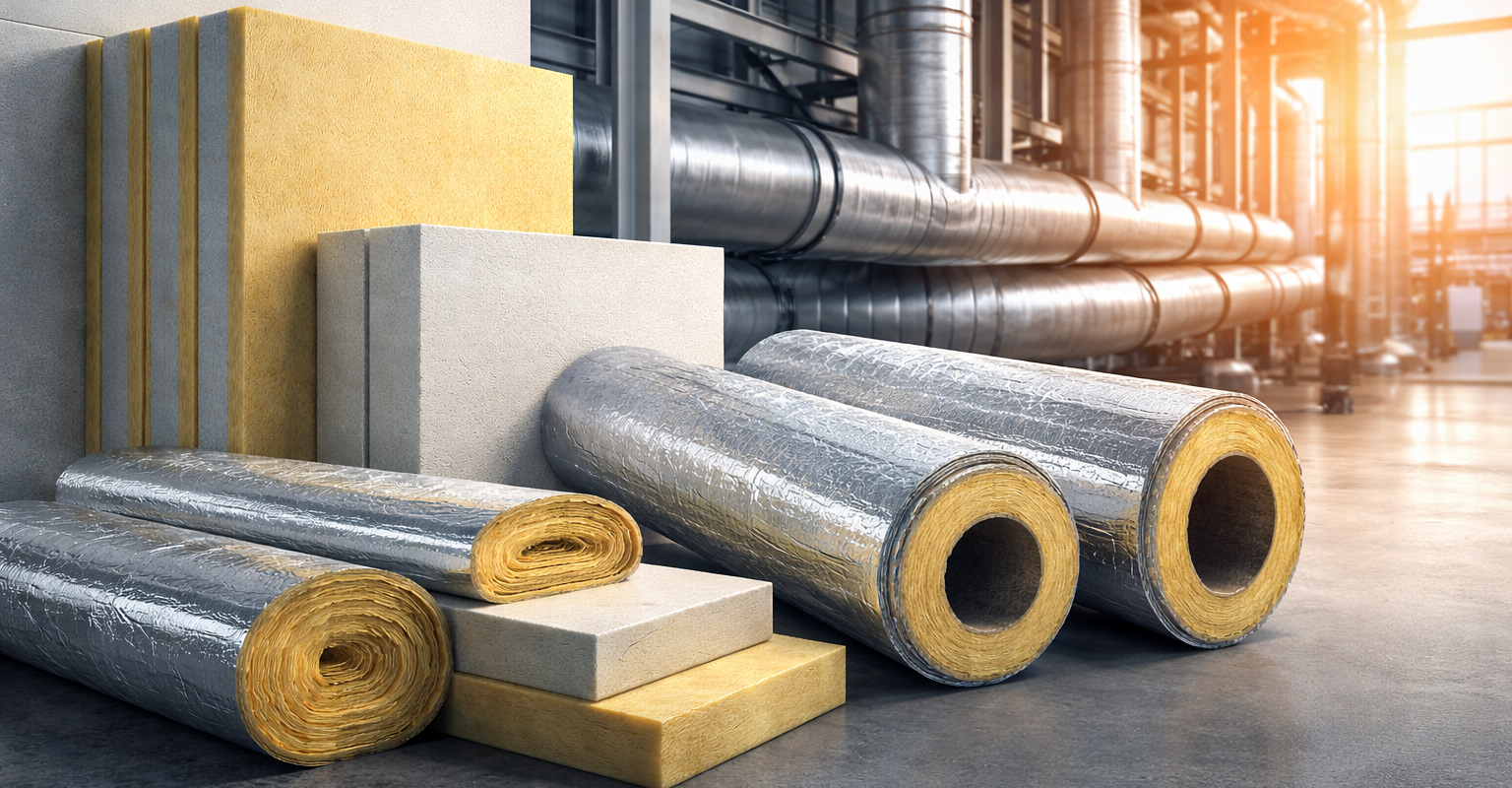
Rigid insulation boards are used in a variety of building-envelope applications.
They can provide a defined thickness and relatively consistent physical form.
Depending on the material, boards may be selected for roofs, walls, floors, foundations, or other applications.
Bituchem’s website identifies Thermal Insulation among its construction product offerings, and its service portfolio includes thermal and acoustic insulation.
For any particular board product, however, the technical datasheet should be reviewed for the exact thermal, mechanical, moisture, fire, and installation properties before specification.
Choosing the Right Thermal Insulation Material
Selecting an insulation material should begin with the building requirement.
The question should not simply be, “Which insulation is cheapest?”
Instead, ask what performance the building requires and under what conditions the system will operate.
Key factors to evaluate:
- Building location and climate
- Roof or wall construction
- Required thermal performance
- Moisture exposure
- Mechanical loading
- Fire requirements
- Installation method
- Compatibility with existing materials
- Maintenance access
- Expected service life
- Project budget
A technically appropriate product can provide better long-term value than a low-cost product that does not match the application.
Avoiding Thermal Bridges
A thermal bridge is an area where heat can move more readily through a building assembly than through the surrounding insulated area.
Thermal bridges can occur around structural connections, slab edges, openings, joints, fasteners, and changes in construction.
They can reduce overall insulation performance.
During design and installation, these areas should therefore be considered carefully.
A continuous insulation strategy can help reduce unwanted heat-flow paths.
However, the specific solution depends on the building system and engineering requirements.
Moisture Management and Insulation
Moisture can affect building materials and, depending on the insulation type, may influence thermal performance or durability.
For this reason, moisture should be considered during system selection and detailing.
Roof assemblies need appropriate drainage and waterproofing.
Wall systems need appropriate moisture-management strategies.
Basements and below-grade applications require additional consideration because of ground moisture and water pressure.
Thermal insulation should therefore not be designed in isolation.
It should work with the complete building-envelope system.
Thermal Insulation and Waterproofing: What’s the Difference?
Thermal insulation and waterproofing solve different problems.
Thermal insulation reduces heat transfer.
Waterproofing is designed to prevent or control water penetration.
However, both systems can be required in the same building area.
A roof, for example, may need both thermal insulation and waterproofing to protect the structure from heat and moisture.
Bituchem’s portfolio includes both thermal insulation and waterproofing solutions, enabling these requirements to be considered together where a project calls for multiple protection systems.
Thermal Insulation and Acoustic Insulation
Thermal and acoustic insulation are also different in their primary objectives.
Thermal insulation addresses heat transfer.
Acoustic insulation addresses sound transmission.
Some materials or assemblies can contribute to both types of performance, but the design requirements are not identical.
Bituchem specifically identifies Thermal & Acoustic Insulation among its specialist services and lists insulation for thermal efficiency and acoustic comfort among its distribution offerings.
For buildings such as hotels, hospitals, offices, residential developments, and institutional facilities, both thermal and acoustic considerations may be relevant.
Thermal Insulation for Retrofitting Existing Buildings
Insulation is not limited to new construction.
Existing buildings can sometimes be upgraded through retrofit insulation.
The feasibility depends on the building’s existing construction, available space, moisture conditions, access, finishes, and budget.
A retrofit assessment should identify the areas responsible for excessive heat transfer and determine which intervention provides the most practical improvement.
In some buildings, roof insulation may be easier to implement than wall insulation.
In others, internal or external wall solutions may be more appropriate.
The decision should be based on the building rather than a generic solution.
Thermal Insulation During New Construction
New construction provides an opportunity to integrate insulation into the design from the beginning.
Architects and engineers can coordinate insulation with structural systems, façades, roofs, windows, waterproofing, mechanical systems, and electrical services.
This can make it easier to maintain continuity and address thermal bridges.
Early planning can also prevent expensive modifications later.
For developers and contractors, thermal performance should therefore be considered during design rather than treated as an afterthought.
Thermal Insulation for Industrial and Commercial Projects
Large projects require a coordinated approach.
Industrial and commercial buildings may contain multiple zones with different thermal requirements.
For example, an office section may require occupant comfort, while a production area may have process-related requirements.
A warehouse may have different requirements from a plant room.
Professional assessment helps determine which areas need insulation and what type of system is appropriate.
Bituchem’s experience across industrial, commercial, residential, hospitality, healthcare, warehouse, infrastructure, and institutional environments supports a project-specific approach.
Cost Considerations for Thermal Insulation
The initial cost of insulation is only one part of the financial decision.
A better evaluation considers the complete lifecycle of the system.
This can include material cost, labour, installation complexity, maintenance, energy consumption, expected service life, and future replacement requirements.
A cheaper product may not necessarily provide better value if it requires more maintenance or does not meet the project’s performance requirements.
Similarly, an expensive system is not automatically the best choice.
The appropriate solution is one that provides the required performance within the project’s technical and financial constraints.
Why Professional Technical Assessment Matters
Every building is different.
Two structures in the same city can have completely different thermal requirements because of differences in orientation, construction materials, roof design, occupancy, air-conditioning systems, and exposure.
Professional assessment can identify these differences.
For larger or technically demanding projects, insulation selection may require input from architects, engineers, contractors, manufacturers, and facility managers.
Bituchem describes its approach as combining construction chemical products with site assessment, technical guidance, and professional execution.
This approach can help ensure that the selected system is aligned with the actual project conditions.
How Bituchem Approaches Thermal Insulation
Bituchem has more than four decades of experience in construction chemicals and specialty contracting.
The company operates both as a specialty contractor and an authorized distributor, allowing it to provide products alongside technical support and application expertise.
Its services include thermal and acoustic insulation, while its product portfolio includes thermal insulation solutions.
Bituchem also works across industrial, commercial, residential, hospitality, healthcare, warehouse, infrastructure, and educational environments.
This combination can be useful for clients looking for a project-specific approach rather than simply purchasing a standalone insulation product.
Why Choose Bituchem for Thermal Insulation Projects?
Choosing an insulation partner involves more than evaluating the product itself.
Technical understanding, application experience, project coordination, product selection, site conditions, and after-sales support can all influence the outcome.
Bituchem states that its approach combines premium-quality products with expert application services, technical precision, project-specific customization, and long-term performance.
The company also reports more than 40 years of industry experience and a broad range of construction chemical and specialty contracting capabilities.
For projects in Jaipur and across other sectors, this broader experience can support integrated construction-protection requirements.
FAQs
1. What is Thermal Insulation?
Thermal insulation is a material or system used to reduce the transfer of heat between different environments. In buildings, it can be applied to roofs, walls, ceilings, floors, and other elements to help manage heat flow and support indoor thermal comfort.
2. Why is Thermal Insulation important in Jaipur?
Jaipur experiences hot summer conditions and seasonal temperature variations. Thermal insulation can help reduce unwanted heat transfer through exposed building elements and can form part of an overall strategy for improving indoor comfort and energy efficiency.
3. Where can Thermal Insulation be used?
Thermal insulation can be used in roofs, walls, ceilings, floors, warehouses, industrial buildings, commercial buildings, residential structures, and other applications where controlling heat transfer is important.
4. How do I choose Thermal Insulation Material Jaipur projects need?
The appropriate material depends on the building type, climate, required thermal performance, moisture exposure, mechanical requirements, fire considerations, installation method, and compatibility with other construction materials. A project-specific technical assessment is recommended.
5. What are Thermal Insulation Products Jaipur businesses commonly looking for?
Depending on the project, requirements can include insulation boards, insulation systems, and other specialized thermal insulation solutions. Product selection should be based on technical specifications and the intended application rather than price alone.
Conclusion
Thermal insulation is an important component of modern building design because it helps control heat transfer and can contribute to indoor comfort, energy efficiency, and better building-envelope performance. However, the effectiveness of insulation depends on more than the material itself. Correct system selection, appropriate thickness, continuous installation, moisture management, thermal-bridge control, detailing, and professional execution all influence the final result.
For projects looking for Thermal Insulation Jaipur, the selection process should begin with an understanding of the building’s actual requirements. Residential homes, offices, hotels, hospitals, warehouses, factories, industrial plants, and infrastructure projects can have very different thermal requirements. This makes a project-specific approach more appropriate than using a one-size-fits-all solution.
When evaluating Thermal Insulation Solutions Jaipur, consider the complete system rather than focusing only on the product. The insulation needs to work with the roof, wall, waterproofing, structural, mechanical, and finishing systems. Similarly, when selecting Thermal Insulation Products Jaipur, technical specifications, compatibility, installation requirements, and long-term performance should be considered alongside cost.
For clients seeking Thermal Insulation Services Jaipur, professional application can be particularly important because gaps, poor joints, thermal bridges, moisture exposure, and incorrect fixing can affect the performance of even high-quality materials. Bituchem provides thermal and acoustic insulation as part of its specialty contracting services and also offers insulation solutions within its construction-chemical distribution portfolio.
With more than 40 years of experience in construction chemicals and specialty contracting, Bituchem combines products, technical guidance, site assessment, and application expertise. Its experience spans industrial and manufacturing plants, residential and commercial buildings, hotels and resorts, healthcare facilities, warehouses, infrastructure, and educational institutions.
Ultimately, the right Thermal Insulation Material Jaipur projects require is determined by the building, environment, construction system, and performance objectives. A well-designed and professionally installed insulation system can become a valuable part of a building’s long-term performance strategy. By evaluating the entire building envelope and selecting solutions based on technical requirements rather than keyword-driven product claims, property owners, architects, developers, and contractors can make more informed decisions about thermal performance and building protection.
